


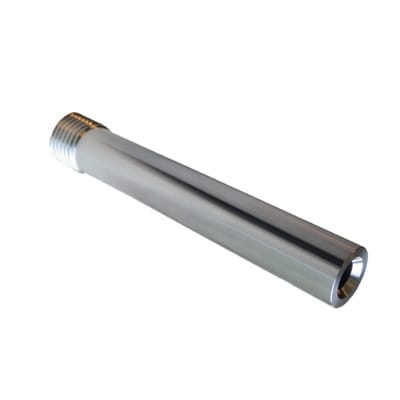
ABCXL Boron Carbide XL Venturi Nozzles
Boron Carbide Extra Long Venturi Nozzle
The ABCXL range comprises of boron carbide lined extra long venturi nozzles with aluminium jacket. These high performance nozzles accelerate particles over a longer distance, achieving higher exit velocities, producing a more concentrated blast pattern and higher production rates. These nozzles are especially suitable to clean the bigger products

Airblast Poland sp.zo.o.
Gdyńska 60
80-297 Miszewo
Poland
Do you have questions about how we can help your company? Send us an email and we’ll get in touch shortly.
- More than 50 years of experience
- Airblast offices in 12 countries
Product description
Boron Carbide is the most durable liner available – therefore these nozzles perform especially well with aggressive abrasives such as aluminum oxide, silicon carbide and steel grit, and are therefore often used in blast rooms.
The ABCXL is available with 1¼” (32 mm) inlet and has a standard 50 mm large thread.
Airblast offers a full selection of nozzles with various orifice sizes, nozzle lengths, insert and liner materials. Contact Airblast to discuss which nozzle is most suitable for your specific application.

Ordering information
| ABCXL – Boron Carbide extra long (XL) venturi nozzle with aluminium jacket | ||||
| Part no. | Description | Orifice | Lenght | Inlet |
| 2304100 | ABCXL-4/50 Boron Carbide XL Venturi Nozzle | 6,4 mm | 305 mm | 32 mm |
| 2304200 | ABCXL-5/50 Boron Carbide XL Venturi Nozzle | 8,0 mm | 305 mm | 32 mm |
| 2304300 | ABCXL-6/50 Boron Carbide XL Venturi Nozzle | 9,5 mm | 305 mm | 32 mm |
| 2304400 | ABCXL-7/50 Boron Carbide XL Venturi Nozzle | 11,1 mm | 305 mm | 32 mm |
| 2304500 | ABCXL-8/50 Boron Carbide XL Venturi Nozzle | 12,7 mm | 305 mm | 32 mm |
| 2304600 | ABCXL-9/50 Boron Carbide XL Venturi Nozzle | 15,1 mm | 305 mm | 32 mm |
Nozzle pressure / Nozzle diameter guide
| ORIFICE (mm) (“) | 60 PSI | 4.2 BAR | 70 PSI | 4.9 BAR | 80 PSI | 5.6 BAR | 90 PSI | 6.3 BAR | 100 PSI | 7.0 BAR | 120 PSI | 8.5 BAR | |||
| 5.0 mm 3/16” | 30.0 171.0 7 | 0.85 77.00 5.3 | 33.0 196.0 8 | 0.93 89.00 5.6 | 38.0 216.0 9 | 1.08 96.00 6.4 | 41.0 238.0 10 | 1.16 108.00 7.1 | 45.0 264.0 10 | 1.27 120.00 7.5 | 58.0 375.0 12 | 1.64 170.00 9.0 | Air Abrasive Power | CFM Lbs./hr. hp | m³/min KG/hr. * kw |
| 6,5 mm 4/16” | 54.0 312.0 12 | 1.53 141.00 9.0 | 61.0 354.0 14 | 1.73 160.00 10.1 | 68.0 408.0 16 | 1.93 185.00 11.6 | 74.0 448.0 17 | 2.10 203.00 12.4 | 81.0 494.0 18 | 2.29 224.00 13.5 | 105.0 660.0 22 | 2.97 300.00 16.2 | Air Abrasive Power | CFM Lbs./hr. hp | m³/min KG/hr. * kw |
| 8.0 mm 5/16” | 89.0 534.0 20 | 2.52 242.00 15.0 | 101.0 604.0 23 | 2.86 274.00 19.1 | 113.0 672.0 26 | 3.20 305.00 20.2 | 126.0 740.0 28 | 3.57 335.00 21.0 | 137.0 850.0 31 | 3.88 385.00 22.9 | 160.0 1.050.0 37 | 4.53 476.00 27.5 | Air Abrasive Power | CFM Lbs./hr. hp | m³/min KG/hr. * kw |
| 9.5 mm 6/16” | 126.0 764.0 28 | 3.57 346.00 21.0 | 143.0 864.0 32 | 4.05 392.00 24.0 | 161.0 960.0 36 | 4.56 425.00 27.0 | 173.0 1.052.0 39 | 4.90 477.00 28.9 | 196.0 1.152.0 44 | 5.55 523.00 33.0 | 235.0 1.475.0 52 | 6.65 669.00 39.6 | Air Abrasive Power | CFM Lbs./hr. hp | m³/min KG/hr. * kw |
| 11.0 mm 7/16” | 170.0 1.032.0 38 | 4.81 468.00 28.5 | 184.0 1.176.0 44 | 5.21 533.00 32.6 | 217.0 1.312.0 49 | 6.14 595.00 36.4 | 240.0 1.448.0 54 | 6.80 657.00 40.1 | 254.0 1.584.0 57 | 7.19 719.00 42.4 | 315.0 2.050.0 69 | 8.92 930.00 50.9 | Air Abrasive Power | CFM Lbs./hr. hp | m³/min KG/hr. * kw |
| 12.5 mm 8/16” | 224.0 1.336.0 50 | 6.34 606.00 37.5 | 252.0 1.512.0 56 | 7.14 686.00 42.0 | 280.0 1.680.0 63 | 7.93 762.00 46.9 | 309.0 1.856.0 69 | 8.75 842.00 51.8 | 338.0 2.024.0 75 | 9.57 918.00 56.3 | 410.0 2.650.0 90 | 11.61 1.202.00 67.6 | Air Abrasive Power | CFM Lbs./hr. hp | m³/min KG/hr. * kw |
Chart shows calculated consumption rates of air and abrasive for new nozzles. When slecting a compressor add 50% to above figures to allow for normal nozzle wear and friction loss.
* Based on abrasive density of 1,5 kgs. per liter.
NOTE: Figures may vary depending upon working conditions. To maintain desired air pressure as nozzle orifice wears, air consumption increases.
The effects of nozzle wear on air consumption must be considered when selecting nozzles and the compressors that support them.

