Robotic blasting provides innovative solutions with the latest advanced technologies to overcome surface treatment challenges and can be incorporated in entire sand blasting and surface treatment lines.




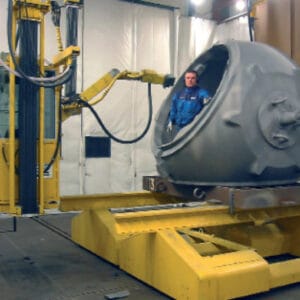
- In house engineering and production
- World-wide project experience
- Standard and custom designed systems
Why choose robotic blasting
Robotic blasting provides speed, consistent results, and a safer way of abrasive blasting. When blasting operations are performed manually, the outcome always depends on the experience and concentration of the operator. This is where robotic solutions add real value. For large, intensive jobs, often carried out in challenging or unsafe conditions, a robot consistently delivers the same result. This makes robotic blasting particularly attractive for companies dealing with series production, complex shapes, or high quality standards.
Safety also plays a major role. Blasting is physically demanding work, and exposure to dust, noise, and vibrations is unavoidable with manual blasting. By using a robot, these risks are shifted from the operator to a controlled system. Employees no longer need to be present in the blasting environment and can monitor the process remotely.
The use of robotic blasting
With robotic blasting, it is essential that all settings are configured in advance. The robotic arm follows pre-programmed movements that are precisely tailored to the product or surface being blasted. These movements can range from simple, repetitive paths to complex motions around corners, edges, and recesses.
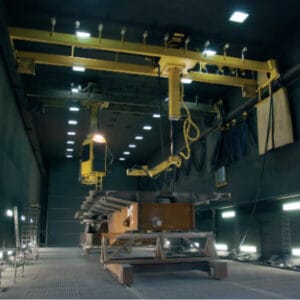
The robot can be integrated into a blasting room or an automated production line. Once the surface is positioned correctly, the blasting cycle starts automatically. The robot moves at a constant speed and distance, ensuring a repeatable and consistent blasting result.
Operators are certainly not redundant in this process. Their role is crucial for supervising the operation, replenishing blasting media, and monitoring quality. This makes the work less physically demanding, safer, and more scalable.
The benefits of robotic sandblasting
One of the biggest advantages is consistent quality. Every cycle is identical, virtually eliminating variations between products. This is especially important for coatings, paint adhesion, and surface preparation according to fixed standards.
In addition, robotic blasting increases production speed. Robots can operate for extended periods and with production up to 200m2 per hour, it’s faster than any manual process. Media consumption is also reduced, as the systems direct the blast precisely to prevent waste. This results in cost savings on blasting media.
Equally important is the improvement in workplace safety. Think of reduced physical strain, less exposure to dust and noise, and a more controlled working environment. Together, these benefits lead to healthier employees and reduced absenteeism.
Our products
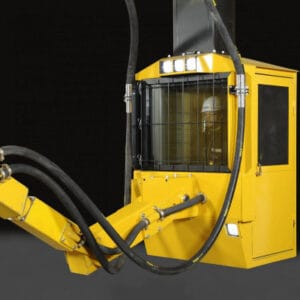
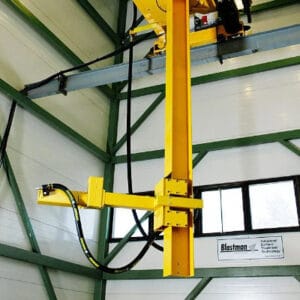
Within our robotic blasting range, various robotic solutions are available, tailored to different applications. From compact robots for smaller components to powerful systems for large industrial objects. The robots can be combined with blasting rooms, conveyor systems, and dust extraction units to create a complete, integrated solution. We are happy to advise you on the optimal configuration of each product, ensuring every job achieves the desired result.
Alternative solutions
Is full automation (yet) unnecessary? In that case, blasting cabinets or semi-automated systems are a suitable alternative. These solutions combine human control with mechanical support, for example through turntables or rail systems.
For smaller batches or frequently changing products, manual blasting may even be more efficient. Robotic blasting truly excels in situations involving repetition, volume, and consistent specifications.
Alternative solutions
Robotic blasting can be used with a wide range of abrasives. These include steel shot and steel grit for heavy-duty cleaning and surface profiling, as well as aluminum oxide and garnet for finer applications. The choice of abrasive depends on the material, the required surface roughness, and the final objective of the blasting process.