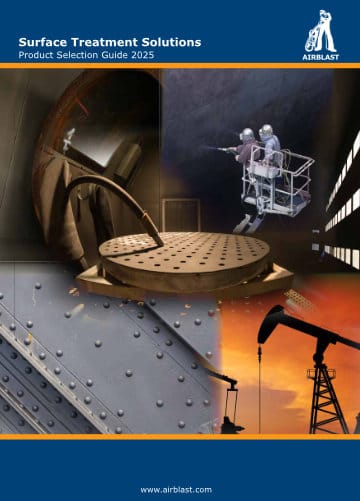
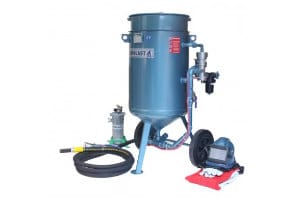
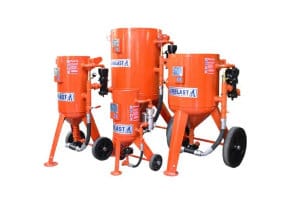
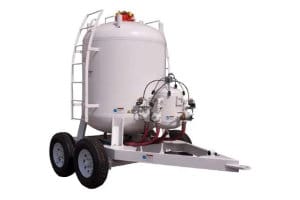
Explore our comprehensive range of blast pots, designed for efficient on-site abrasive blasting, surface preparation, and industrial cleaning. Whether you need a standalone unit or a complete blasting system, we provide solutions tailored to your application, from maintenance and offshore work to heavy-duty steel treatment.
In practice, the right blast pot setup depends on factors such as air capacity, abrasive type, nozzle configuration, and project conditions. That is why we do not just supply equipment, but help you select a configuration that delivers consistent performance, reliability, and cost efficiency in real-world operations.
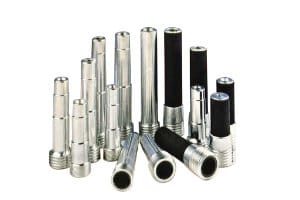
- In house engineering and production
- World-wide project experience
- Standard and custom designed systems
Choosing the right blast pot for the job
Blast pots are used for abrasive blasting in maintenance, corrosion removal, and coating preparation. They clean steel, concrete, and other industrial surfaces while creating the right surface profile for a new protective coating. In practice, the right setup depends not only on the blasting job itself, but also on factors such as compressor capacity, abrasive consumption, and the duration of the work.
Smaller blast pots are often used for local repairs, low-pressure blasting, or short-duration applications where mobility is essential. Larger units are better suited to continuous blasting operations where higher output and fewer interruptions are required. At Airblast, we supply blast pots in different capacities, from compact units for flexible field use to larger systems for demanding industrial surface treatment projects.
What determines blast pot performance in practice?
Blast pot performance is determined by more than the vessel alone. In abrasive blasting, the combination of air supply, nozzle size, hose layout, and abrasive type directly affects cleaning speed, surface quality, and operating efficiency. A blast pot that is correctly matched to the job, together with the right blasting accessories, will deliver a more stable blasting pattern and more predictable results on site.
For example, insufficient compressor capacity leads to pressure loss at the nozzle, which reduces impact energy and lowers productivity. Nozzle wear can have a similar effect over time, as a larger nozzle opening changes air consumption and blasting performance. That is why selecting a blast pot should always be linked to the full blasting setup, not just to pot capacity.
What is the difference between blast pots and blast rooms?
A blast pot is built for flexibility. You use it on-site for maintenance, steel structures, or large objects that cannot be moved. The system feeds abrasive through a blast hose, allowing operators to work directly on location. This makes it versatile, but also more dependent on operator skill and environmental conditions. A blast room, on the other hand, creates a fully controlled environment with dust extraction and abrasive recovery systems. This leads to a more consistent surface finish, higher safety, and better efficiency in repetitive or large-scale projects.
In practice, the choice depends on how you work. If you need mobility and adaptability, a blast pot is the right fit. If your focus is on process control, repeatability, and throughput, a blast room offers more long-term value.
The Advantages of Professional Blast Pots
Professional blast pots are designed for efficient abrasive blasting in field operations, maintenance work, and industrial surface preparation. When correctly configured, they remove corrosion, failed coatings, and contamination while preparing the substrate for better coating adhesion. Their main advantage lies in combining mobility with process control, especially in projects where the workpiece cannot be moved to a fixed blasting installation.
- Suitable for on-site blasting of large or fixed structures
- Supports effective removal of rust, coatings, and surface contamination
- Helps create the required surface profile for protective coatings
- Available in different sizes for local repair work and continuous blasting projects
- Can be matched to compressor output, abrasive type, and project conditions
Blasting solutions tailored to your industry
Maintenance, offshore & shipbuilding
In industries where work happens on location, flexibility is essential. Mobile blasting solutions allow operators to treat large steel structures, ship hulls, and installations directly on-site, without the need for transport. This approach keeps projects efficient while maintaining full control over surface preparation in varying conditions.
Manufacturing & production
In manufacturing and production environments, blast pots are often used for flexible surface treatment tasks, repair work, and applications where components vary in size or condition. Where higher throughput and repeatability are required, they are often combined with more controlled blasting setups. This makes blast pots especially valuable in operations that need both adaptability and reliable surface preparation across different job types.
Large-scale & heavy-duty applications
For large objects and heavy-duty field applications, blast pots remain a practical solution where mobility and direct access are essential. In projects with continuous workflows or strict process control requirements, they are often evaluated alongside enclosed blasting installations. This helps operators choose the most effective setup for surface quality, efficiency, and working conditions.
Explore our full range of sandblasting machines to find the right solution for your industry.
Common misconceptions about blast pots
We often see companies choose a blasting solution based on flexibility or initial cost, rather than the actual requirements of the job. A blast pot is often selected as the “safe” option, while the project demands more control, consistency, or efficiency.
The result becomes clear during execution: longer processing times, inconsistent surface quality, and higher abrasive consumption than expected. These situations rarely come down to the equipment itself, but to a mismatch between the application and the chosen setup. That is why experienced operators start with the process and desired end result before deciding on the machine. In practice, we see four common mistakes.
Choosing a blast pot for repetitive production
A common mistake is using a blast pot for serial or high-volume work. While powerful, it remains a manual process, which leads to variation in quality and lower efficiency. Automated systems or enclosed solutions, such as blast rooms, deliver more consistent results in these cases.
Underestimating environmental impact
Blast pots are often used in open environments, where dust dispersion and abrasive loss can become a serious issue. This increases material costs, creates safety risks, and adds cleanup time. In these situations, we often advise clients to consider enclosed systems for applications that require better containment, abrasive recovery, and more efficient long-term operation.
Incorrect compressor and setup requirements
A blast pot only performs well with the right air capacity and setup. Insufficient compressor output or poor hose configuration leads to pressure loss, inconsistent blasting, and reduced productivity.
Needing control but choosing flexibility
In projects where surface consistency and coating requirements are critical, a blast pot is not always the right choice. Controlled environments provide better repeatability and process control.
Choosing the right solution starts with understanding the application, not just the equipment.
When is a blast pot the right choice?
A blast pot is the right solution when abrasive blasting needs to be carried out on-site and the workpiece cannot be moved to a fixed installation. This is common in projects involving steel structures, bridges, tanks, ship maintenance, and industrial shutdown work. In these situations, a blast pot allows operators to work directly on location with the flexibility needed for effective surface preparation.
It is also the preferred choice for variable or one-off projects. When surfaces differ in size, shape, or condition, a manual setup offers the adaptability that automated systems lack. In these situations, an experienced operator can adjust pressure, abrasive flow, and technique in real time to achieve the desired result.
In short, when your work requires mobility, adaptability, and reliable on-site surface preparation, a blast pot delivers the most practical and efficient solution.