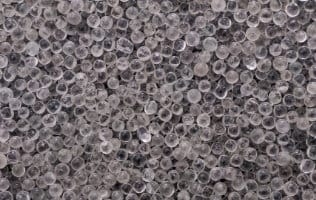
Glass bead blasting uses small, spherical glass beads propelled by compressed air to clean and finish a surface. It is commonly used on stainless steel and aluminium when an even, matt or satin appearance is required.
The finished surface depends on the material, its original condition, the blasting media and the process settings. This guide explains how glass bead blasting works and what to consider when selecting media and equipment.
How does glass bead blasting work?
Compressed air carries glass beads through a blasting nozzle and onto the workpiece. The rounded particles produce a peening action that differs from the cutting action of angular abrasives.
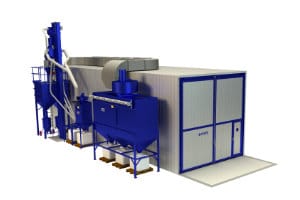
Small components can be treated in a blast cabinet, while larger fabrications may require a blast room. Suitable recovery and separation systems allow reusable media to be collected while removing dust and contaminants.
Bead size, air pressure, nozzle selection, working distance and operator movement all influence the result. Consistent settings and coverage are important when several components need a matching finish.
What finish does glass bead blasting produce?
Glass bead blasting can create a non-directional, matt or satin finish. The appearance and texture vary with the starting surface, the condition of the beads and the intensity of the treatment.
A visually uniform surface is not necessarily a smoother surface. Where surface roughness matters, specify the required result and measure it after treatment rather than judging the finish by appearance alone.
For visible components, agree an acceptable reference sample before processing a batch. This gives both the operator and the customer a practical basis for assessing consistency.
What is glass bead blasting used for?
Glass bead blasting is used for surface cleaning and finishing where the appearance and condition of the treated metal are important. Suitability should be assessed against the requirements of the individual component.
Glass bead blasting stainless steel
Stainless steel applications include visible fabrications, panels and machine components requiring an even finish. Large surfaces need particular attention because variations in coverage can leave visible bands or patches.
Keep media and equipment free from unwanted iron contamination. Clean the workpiece before and after treatment, and monitor the condition of recovered media. A build-up of broken beads can change the texture and consistency of the finish.
Glass bead blasting aluminium
Glass bead blasting is also used to clean and finish aluminium components. The appropriate process depends on the alloy, component geometry, original surface and required appearance.
Assess thin sections, delicate features and surfaces with dimensional requirements before treatment. Use a representative test component to confirm that the selected media and settings produce an acceptable result.
Components with hygienic surface requirements
Food-processing and medical components may have specific requirements for surface roughness, cleanability and subsequent treatment. Define these requirements before selecting a blasting process.
A matt appearance or a single roughness measurement does not, by itself, establish that a component meets every requirement for its intended use.
How do you select glass bead blasting media?
Select glass beads according to the workpiece, the required finish and the capabilities of the blasting system. Particle size is one part of that decision, alongside pressure, nozzle choice and media condition.
Airblast supplies glass bead blasting media in sizes including 40–70, 70–110 and 100–200 µm. The product page lists the available sizes and specifications.
Before choosing a grade, establish:
- The material and condition of the incoming component.
- The required visual finish and any measured surface specification.
- The size and shape of the workpiece.
- The equipment, nozzle and media recovery system available.
- The acceptance criteria for a test piece or production sample.
What pressure and surface roughness should you specify?
There is no single pressure setting or Ra value that applies to every glass bead blasting job. Establish suitable settings through the equipment and media guidance, followed by testing on a representative workpiece.
Ra is a commonly used measure of average surface roughness, usually expressed in micrometres, or µm. If it forms part of the acceptance criteria, agree the required value and measurement method before production.
Record the settings used for an approved sample. This helps maintain consistency when repeating the process or treating a larger batch.
Glass bead blasting vs angular abrasive blasting
Glass beads and angular abrasives act differently on a surface. Round beads are often selected for finishing, while angular media are commonly used where stronger cutting action or a coating anchor profile is required.
For heavy coating removal or demanding surface preparation, assess whether another abrasive is more suitable. If a coating follows blasting, use the coating system’s preparation requirements to guide the choice.
Compare the available blasting abrasives against the job rather than selecting media solely by the desired appearance.
When should you consider the ROTIN blasting principle?
The ROTIN blasting principle uses a rotating insert to distribute the blast pattern more evenly. It is particularly relevant when visible variations in the finish need to be reduced, including on larger stainless steel surfaces.
Airblast supplies Rotin beads selected for use with this concept. The media, equipment and process settings should be assessed together against the required appearance and surface roughness.
Where a low Ra value is specified, confirm the result on the treated component rather than assuming that the choice of blasting concept alone guarantees compliance.
Choose media and equipment for your application
Airblast supplies glass beads, Rotin beads, blast cabinets and blast rooms. To discuss a suitable setup, provide the workpiece material, dimensions, production requirements and target finish.
Contact Airblast for advice on glass bead blasting media and equipment.