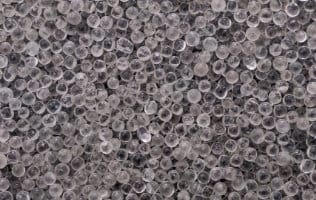
Glass bead blasting uses small, round glass beads as blasting media. These beads clean, compact and refine the surface without aggressively cutting into the base material. This creates an even, matte or satin-like finish that manufacturers often use on stainless steel, aluminium and other metals.
Unlike blasting with angular abrasives, glass bead blasting is not primarily used to create a rough anchor profile. The goal is to make the surface smoother, cleaner and more visually consistent. That is why companies often choose glass bead blasting when the final surface remains visible or when the surface must meet hygienic requirements.
Companies that work with stainless steel parts, machine frames, welded constructions or components for the food industry often use glass bead blasting as an important final finishing process. The surface not only looks cleaner, but is often easier to clean as well.
How does glass bead blasting work?
During glass bead blasting, compressed air propels fine glass beads against the workpiece. The round shape of the beads creates a different effect than sharp-edged blasting media. While angular grit roughens the surface, glass beads impact and roll across the surface, creating a polishing and compacting effect.
Operators usually carry out the process in a blast cabinet or blast room. This offers two advantages. The operator works in a controlled and safe environment, and the system collects, cleans and reuses the glass beads after blasting. This makes glass bead blasting suitable for repetitive work and precise surface treatment.
The final result depends on the right settings. Air pressure, distance from the workpiece, blasting angle, operator movement and bead size all influence the finish. This is especially important when blasting stainless steel. Incorrect settings can cause visible streaks, marks or an uneven surface.
What is glass bead blasting used for?
Glass bead blasting is used when a surface needs to be clean, even and visually appealing. The technique works well on various materials, including steel, aluminium and stainless steel. Companies often use it for stainless steel because it creates a calm, matte finish without making the material unnecessarily rough.
Common applications include:
- removing light rust, dirt, oil, contamination and light coatings;
- finishing stainless steel surfaces with a matte or satin-like appearance;
- removing discoloration caused by welding, bending or machining;
- smoothing surfaces so dust and dirt adhere less easily;
- improving cleanability for parts used in hygienic environments;
- strengthening the surface through a peening effect;
- preparing stainless steel for a follow-up process, such as powder coating.
On stainless steel, companies use glass bead blasting both as a final treatment and as a pre-treatment. If the end product remains visible, the focus is often on appearance. If the part is used in an industrial or hygienic environment, cleanability, roughness and corrosion resistance become more important while choosing the correct blasting media.
Glass bead blasting vs. sandblasting: what is the difference?
Glass bead blasting and sandblasting are often mentioned together, but they serve different purposes. Traditional blasting is usually focused on cleaning, derusting and roughening the surface. It creates a surface profile that helps paint, coating or another protective layer adhere properly.
Glass bead blasting focuses more on refinement. The glass beads do not create a rough surface, but make it more even and smoother. This makes glass bead blasting particularly suitable when the base material must remain intact and the surface needs a neat final finish.
For heavy rust removal or the removal of thick coating layers, other blasting media are often more effective. For stainless steel finishing, light cleaning and visual refinement, glass bead blasting is usually the better choice.
What pressure should be used for glass bead blasting?
Operators usually perform glass bead blasting at relatively low pressure. In practice, operators often use a pressure between approximately 2.5 and 5 bar. Lower pressure helps treat the surface in a controlled way and prevents the glass beads from breaking too quickly. This extends the lifespan of the blasting media and creates a more consistent finish.
Higher pressure increases impact. This may seem useful when faster work is required, but it also increases the risk of an uneven surface, visible blasting marks or unnecessary roughening. Especially with stainless steel, control is more important than speed.
Bead size also plays an important role. Operators commonly use glass beads of approximately 100 to 200 µm for general glass bead blasting. For applications with stricter roughness requirements, such as the food or medical industry, companies often choose finer glass beads.
Surface roughness in glass bead blasting: why Ra value matters
Engineers often express surface roughness as Ra. This value indicates how smooth or rough a surface is on average. In glass bead blasting, surface roughness is important because the surface often needs to remain clean, smooth and easy to clean.
With standard glass bead blasting at low pressure, operators can achieve a roughness of approximately Ra 1.5 µm. For many general industrial applications, this is sufficient. In sectors such as the food industry and medical industry, requirements are often stricter. In these environments, the surface must be smooth enough to reduce the adhesion of dirt, bacteria and product residues.
In these situations, choosing glass beads alone is not enough. The blasting technique, pressure, nozzle and operator experience all determine whether the required roughness can be achieved.
What is the ROTIN blasting principle?
The ROTIN blasting principle makes spot-free glass bead blasting possible, especially on stainless steel. Standard blasting nozzles often create a narrow, straight blast pattern with a clear hotspot. This hotspot hits the surface more intensely than the edges of the blast pattern. If the operator does not overlap the blasting paths perfectly, visible spots or streaks can appear.
ROTIN works differently. A rotating insert sits in front of the blasting nozzle. This insert widens the blast pattern and distributes the impact more evenly across the surface.As a result, one concentrated core does not hit the workpiece. Instead, a wide, rotating blast pattern treats the surface with consistent intensity.
The result is a calmer and more consistent blasting finish. This makes a major difference on larger stainless steel surfaces. While standard glass bead blasting often requires extensive operator experience, ROTIN makes it easier to achieve a spot-free final result.
When should you choose ROTIN instead of standard glass bead blasting?
Standard glass bead blasting works well for many cleaning and finishing applications. Think of removing light contamination, matting small parts or treating surfaces where minor visual differences are acceptable.
ROTIN becomes especially valuable when the final result is critical. This applies to large stainless steel sheets, machine parts, visible surfaces, constructions for the food industry or components for medical applications. In these situations, the surface must not only be clean, but also even, spot-free and reproducible.
With ROTIN, operators can achieve very low roughness values at low pressure and with fine glass beads. In combination with the right blasting media, values below Ra 0.8 µm are possible. For applications where hygiene, cleanability and visual quality come together, this offers a clear advantage.
Common mistakes in glass bead blasting
A good final result starts with the right combination of blasting media, pressure, equipment and technique. In practice, problems often occur when one of these factors is not properly matched to the material.
Excessive pressure can cause glass beads to break faster and place unnecessary stress on the surface. The wrong bead size can create a finish that is too rough or not effective enough. Irregular blasting movements can also quickly cause stains or streaks, especially on stainless steel.
Contamination of the blasting media is another important point of attention. If glass beads mix with steel particles or other abrasive grit, this can affect the surface and its corrosion resistance. Always work with clean equipment and blasting media that are suitable for the material and application.
Conclusion: glass bead blasting for a smooth, clean and even surface
Glass bead blasting effectively cleans, mattes and refines metal surfaces. The round glass beads create a smooth, satin-like finish without producing an aggressive anchor profile. This makes it especially suitable for stainless steel, aluminium and parts where appearance, cleanability and surface quality are important.
For general cleaning or light finishing, standard glass bead blasting is often sufficient. When working with large stainless steel surfaces, spot-free visible work or very low roughness values for the food or medical industry, the ROTIN blasting principle offers clear advantages. The even rotating blast pattern creates a more consistent, cleaner and more reproducible finish.
To get the best result from glass bead blasting, it is important to look beyond the blasting media alone. Equipment, pressure, bead size, nozzle and application all matter. It is this combination that determines whether the surface meets both technical and visual requirements.